Art
Key Curriculum Information
Art Long Term Plan and Curriculum Progression
Intent of Art at Woodlands
At Woodlands, we want art to be a joyful, expressive and inclusive part of every child’s learning journey. Our art curriculum nurtures creativity, imagination and confidence by providing opportunities to explore, experiment and communicate through a wide range of media. We believe all children are artists and that their ideas and individuality should be celebrated.
Our pupils learn to use drawing, painting, sculpture and other materials to express themselves and to represent the world around them. They learn to notice details, make choices about colour, texture and shape, and talk about what they see and create. Children are introduced to a variety of artists, craftspeople and designers to inspire them and help them see that art is everywhere.
Through engaging and inclusive experiences, we want our pupils to:
- Explore and enjoy a wide range of art materials and techniques.
- Express ideas, feelings and experiences visually.
- Develop fine motor skills through mark making and tool use.
- Talk about their own artwork and respond to the work of others.
- Be inspired by a diverse range of artists, styles and cultures.
Our curriculum reflects our school values of Creativity, Curiosity, Independence, Kindness, Respect and Belief. It gives children the freedom to explore and the structure to grow in skill and confidence.
Why Art matters to our pupils
- - Art offers a powerful means of self-expression for all children, especially those with emerging language skills.
- - It helps develop confidence, perseverance and pride in their own work.
- - It supports wellbeing and emotional development.
How our Art curriculum is bespoke to Woodlands and reflects our context and values
- Children are encouraged to share ideas, celebrate differences and take creative risks.
- The curriculum draws on pupils’ lived experiences and interests, including links to the natural world, local environment and school events.
- Children explore a range of art forms and materials regardless of prior exposure or background.
- Designed to celebrate and nurture creativity in every child, regardless of their starting points or previous artistic experiences.
- Provides rich opportunities for sensory exploration, imaginative expression and fine motor development, building the foundations for confident artistic practice.
- Draws inspiration from a diverse range of artists, including figures with strong local links such as Surrealist artist Emmy Bridgwater from Solihull and the many public art installations across Shirley and the wider borough.
- Connects pupils to their local environment through exploration of public artworks, such as the Shirley Poppy Sculpture and the Solihull Colour Palette, helping them develop pride in their community and an understanding of how art shapes our shared spaces.
- Encourages every child to think, talk and believe in themselves as artists, developing confidence, resilience and a lifelong appreciation of creativity.
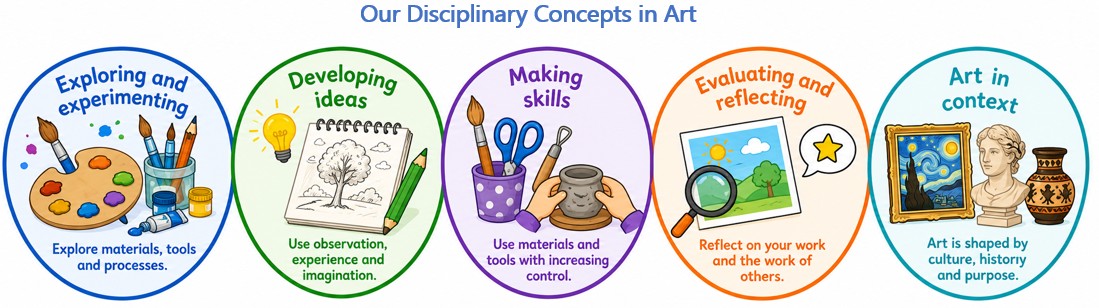
Key Disciplinary Concepts in our Art Curriculum
We want our pupils to think like an artist. To do this, they need to:
- Try out different tools, materials and ideas (Exploring and Experimenting).
- Use experiences and imagination to create and improve their work (Developing Ideas).
- Practise skills like cutting, joining and shaping (Making Skills).
- Talk about their own art and other people’s art (Evaluating and Reflecting).
- Learn about different artists and why people make art (Art in Context).
Substantive Themes in our Art Curriculum
In Art, substantive knowledge refers to the specific media, materials, processes and artistic traditions pupils study. These are organised into four recurring themes…
- Drawing
- Sculpture
- Painting and Mixed Media
- Art in the Local Environment
Substantive themes are built upon from Nursery to Year 2, allowing children to revisit and develop techniques and confidence over time. They are sequenced and mapped in detail in the Skills Progression document.
How learning deepens from EYFS to Year 2
In Nursery and Reception, Art is taught through a balance of adult-led input and continuous provision. Children explore materials through structured units alongside open-ended opportunities for experimentation and sensory play. Foundational skills in mark making, colour mixing and modelling are developed progressively, preparing pupils for more formalised units in Key Stage 1.
In Key Stage 1, Art is taught through carefully sequenced units that build knowledge and skills progressively. Each unit includes opportunities for exploration, sketchbook development, explicit modelling of techniques and reflection. Vocabulary is introduced and revisited regularly, and pupils study a range of artists to inspire their own creative outcomes. Practical observation, discussion and annotated outcomes are used to assess progress.
Detailed sequencing and progression are set out in the Art Long Term Plan and Progression document.
How progress is assessed and evaluated
- We have clear age-related expectations for each year group. Teachers assess progress through observation, discussion, sketchbooks and final outcomes, ensuring that pupils develop increasing control, independence and confidence over time.
- Teachers and Subject Champions track development using practical observation and annotated outcomes on Whole Class Feedback Sheets.
- Progress is measured through skill development, vocabulary use and increasing independence.