
Mathematics
Key Curriculum Information
Maths Long Term Plan and Year Group Overviews
Intent of Maths at Woodlands
At Woodlands, we believe that strong foundations in number fluency underpin all mathematical success. As half of our pupils are in the Early Years, we prioritise secure number sense from Nursery onwards, recognising that early understanding of number, pattern and structure is critical for longterm achievement.
Our curriculum is carefully sequenced using White Rose Maths and informed by NCETM Teaching for Mastery principles. We follow a mastery approach in which the majority of pupils move through the curriculum at broadly the same pace, developing depth through reasoning and problem solving rather than acceleration into new content.
We want our pupils to see themselves as mathematicians — confident, capable and curious. Through carefully structured small steps, pupils develop automatic recall, conceptual understanding and the ability to apply mathematics with precision and independence.
Through purposeful and language-rich teaching, we aim for pupils to:
- Develop secure number sense and automatic recall of key facts
- Recognise patterns and mathematical structure
- Represent and explain their thinking clearly
- Solve problems with confidence and resilience
- Experience success and enjoyment in mathematics
Our mathematics curriculum supports our school values of Belief, Curiosity, Independence, Creativity, Respect and Kindness. Pupils learn that mistakes are part of learning and that perseverance strengthens understanding.
Why Mathematics matters to our pupils
Mathematics develops logical thinking, precision and clarity. It enables pupils to make sense of the world and equips them with skills they will use throughout their lives.
Strong number fluency reduces cognitive load, allowing pupils to focus on reasoning and problem solving. By securing foundational knowledge early, we ensure pupils are prepared for the increasing complexity of mathematics in Key Stage 2 and beyond.
Mathematics at Woodlands develops:
- • Attention to detail
- • Systematic thinking
- • The ability to justify and explain
- • Confidence in tackling unfamiliar challenges
We want our pupils to leave Year 2 as fluent, thoughtful and resilient mathematicians.
How our Maths curriculum is bespoke to Woodlands
At Woodlands, half of our pupils are in the Early Years. This shapes our curriculum design. We prioritise strong foundations in number, ensuring that secure early number sense is established before formal abstraction is introduced.
In Nursery and Reception, mathematics is taught through structured whole-class sessions alongside carefully planned provision. Key concepts are explicitly introduced, modelled and rehearsed before being reinforced through practical exploration. This ensures learning is both language-rich and conceptually secure.
A significant proportion of our pupils speak English as an additional language. Therefore, precise mathematical vocabulary is explicitly taught and systematically revisited across the school. Regular mathematical talk, modelled sentence stems and structured discussion enable pupils to articulate reasoning with clarity and confidence.
We adopt a consistent concrete–pictorial–abstract approach. Manipulatives and visual models are used deliberately to reveal mathematical structure and support understanding before pupils move to abstract representations.
Daily fluency practice strengthens automatic recall and supports long-term retention of key number facts.
Disciplinary Thinking - We want our pupils to think and work like a mathematician
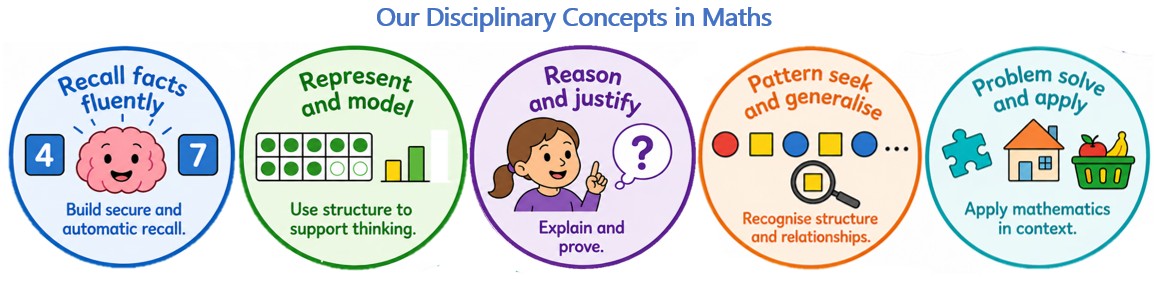
To do this, they develop disciplinary understanding alongside substantive knowledge. Pupils learn to build fluency, use representations strategically, reason with precision, recognise mathematical structure and apply knowledge confidently in a range of contexts.
Our disciplinary concepts in maths are:
How learning deepens from EYFS to Year 2
In the Early Years, mathematics is rooted in structured exploration and explicit teaching. Pupils develop early number sense through counting, subitising, composing and comparing quantities. Whole-class sessions introduce key concepts, which are reinforced through purposeful provision and practical application.
In Year 1, mathematics becomes more structured and formalised. Pupils secure place value understanding, develop fluency in addition and subtraction and begin exploring multiplication and division through equal groups and arrays.
In Year 2, independence, efficiency and abstraction increase. Pupils apply number facts confidently, use formal representations and justify their reasoning with increasing precision. Multiplicative relationships strengthen and connections between strands become more explicit.
By the end of Year 2, pupils demonstrate secure number fluency, flexible thinking and the ability to solve increasingly complex problems with confidence.
How progress is assessed and evaluated
We have clear age-related expectations for each year group. Teachers assess progress through daily formative assessment, retrieval practice, questioning, pupil explanations, written outcomes and structured fluency checks.
Assessment focuses on:
- Security of number fluency
- Accuracy and efficiency of calculation
- Use of representations
- Quality of reasoning
- Ability to apply knowledge in new contexts
Subject leaders monitor progression through lesson visits, book looks and pupil voice to ensure that fluency, reasoning and problem solving develop consistently across the school.