
Design Technology
Key Curriculum Information
Design Technology Long Term Plan and Curriculum Progression
Intent of DT at Woodlands
At Woodlands, we want Design and Technology to inspire children to be imaginative problem-solvers who enjoy creating purposeful products. Our DT curriculum nurtures curiosity, creativity and practical thinking. Children are encouraged to design, make and evaluate with increasing independence, developing skills that are useful in everyday life.Through a variety of creative and practical activities, children learn to work with tools, materials and components safely and effectively. They are encouraged to explore how things work, make improvements and talk about their design decisions. DT provides opportunities to link learning to real life, developing an understanding of function, purpose and user needs.
Through purposeful and engaging experiences, we want our pupils to:
- Explore how everyday objects are made and used.
- Design and make simple products with a clear purpose.
- Use tools and equipment safely and with control.
- Evaluate their own work and suggest improvements.
- Work both independently and collaboratively.
Why Design and Technology matters to our pupils
- Design and Technology encourages hands-on, practical learning.
- It develops independence, creativity and logical thinking.
- Through designing and making, pupils build fine motor control, technical vocabulary and confidence in solving real problems.
How our DT curriculum is bespoke to Woodlands and reflects our context and values
- We use everyday materials and familiar products to explore design ideas.
- DT projects are often linked to school themes and real-life contexts and experiences. They create things for meaningful purposes, often creating things for people they know.
- Units are linked to Shirley where possible. For example, bridges are linked to those by Shirley Railway Station.
- Children learn to respect materials, tools and each other’s work.
- Tools and materials are chosen to be accessible and familiar to our children.
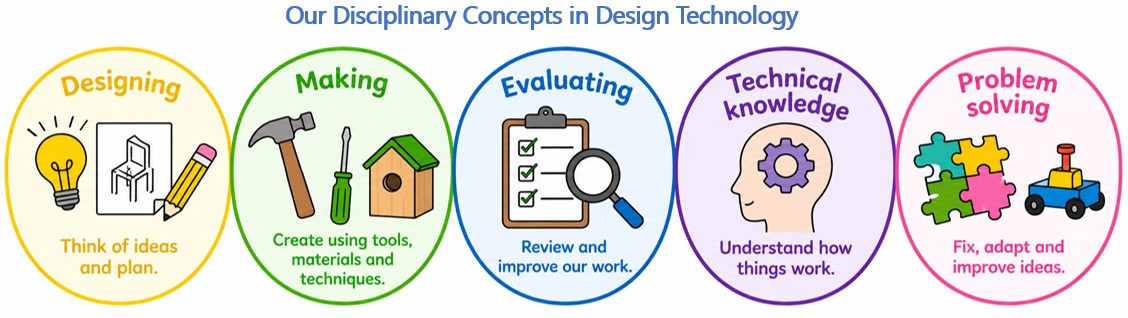
Key Disciplinary Concepts in our Design Technology Curriculum
We want our pupils to think and work like a designer. To do this, they need to:
- Design – Generate purposeful ideas for products to meet a need or solve a problem.
- Make – Select and use materials, tools and techniques with increasing skill and accuracy.
- Evaluate – Reflect on the design process and end product to suggest improvements.
- Have technical Knowledge – Understand how structures, mechanisms and materials work.
- Problem Solve – Overcome challenges through creativity, testing and adaptation
Substantive Themes in our Design Technology Curriculum
In Design and Technology, substantive knowledge refers to the materials, components, mechanisms and processes pupils’ study. These are organised into five recurring themes which are revisited and developed from Nursery to Year 2:- Nutrition and Food
- Textiles and Materials
- Mechanisms and Movement
- Structures and Construction
- Everyday Products and Local Design
How learning deepens from EYFS to Year 2
In the Early Years, Design and Technology is rooted in exploration, curiosity and purposeful play. Children develop early foundations in imagining, joining, shaping and improving through structured provision and guided practical experiences. Technical understanding begins as they notice how materials behave, how structures stand and how simple mechanisms create movement. Evaluation is largely verbal and supported by adult modelling.In Key Stage 1, Design and Technology builds on these exploratory foundations and becomes more structured and explicit. Pupils move from play-based experimentation to a clear and iterative design process. They design with increasing intention, follow a sequence of design–make–evaluate, and begin to work against simple design criteria. Technical knowledge becomes more secure and deliberate, with explicit teaching of mechanisms, structural strengthening, material selection and principles of healthy food preparation.
From Year 1 to Year 2, independence, precision and analytical thinking deepen. Making becomes more accurate, technical understanding more secure and evaluation more systematic. By the end of Year 2, pupils apply prior learning confidently to new design challenges, demonstrating resilience, responsibility and control.
How progress is assessed and evaluated
- We have clear age-related expectations for each year group. Teachers assess progress through observation, discussion, design drawings, practical outcomes and evaluation of finished products, ensuring that pupils develop increasing control, technical understanding, independence and confidence over time.
- Teachers and Subject Champions track development using practical observation and annotated outcomes on Whole Class Feedback Sheets.
- Progress is seen in independence, control, creativity and ability to explain design thinking.