
Smartphone Free Childhood
Childhood happens in real life
At Woodlands, we strongly believe that childhood should not be dominated by smartphones, social media or screens.
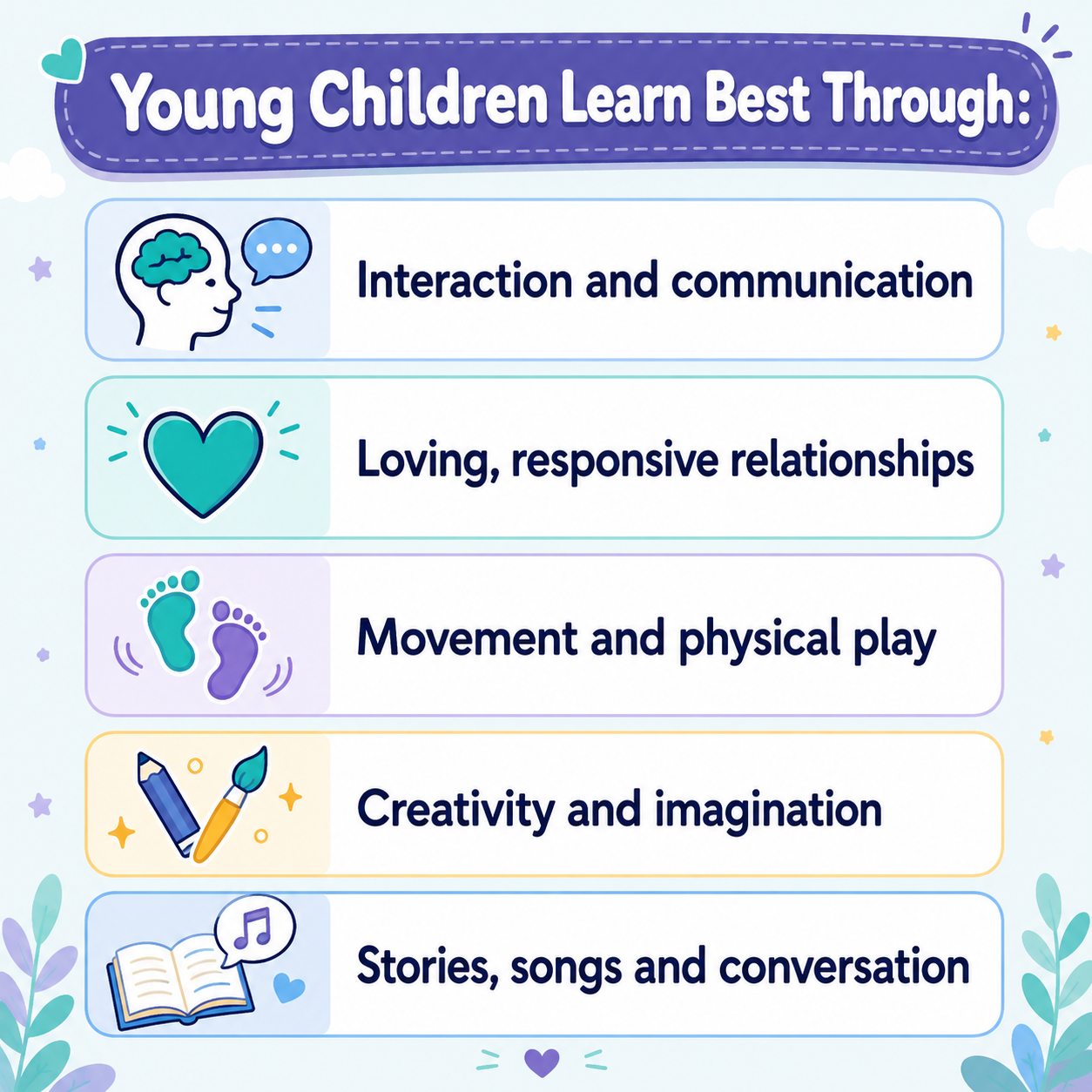
Young children’s brains are developing rapidly. During these important early years, children need conversation, imaginative play, physical activity, sleep, exploration, stories and warm, responsive relationships with other people. These real-life experiences help children develop their language, attention, emotional regulation, social understanding, independence and ability to learn.
We are increasingly concerned about the effect that excessive, premature and poorly supervised screen use can have on children’s development. When screens replace conversation, play, movement, sleep or face-to-face interaction, children can miss experiences that their developing brains and bodies need.
Government guidance for early years providers now recommends a precautionary approach to screen use. It states that screens should be used sparingly and intentionally and that excessive screen time is associated with poorer cognitive and behavioural development, reduced verbal activity and vocabulary, developmental delays, reduced attention and lower executive functioning.
For these reasons, Woodlands supports the principles of Smartphone Free Childhood and the local Solihull IRL – In Real Life campaign.
Our position
We are not opposed to technology. Technology can support learning, communication and creativity when it is carefully chosen, age-appropriate and used for a clear purpose.
However, we do not believe that young children need unrestricted access to smartphones, social media, online videos or internet-connected devices. We strongly encourage families to delay giving children their own smartphones and to establish healthy boundaries around screens from an early age.
A smartphone is not simply a telephone. It can provide continuous access to messaging, social media, games, videos, advertising and content designed to hold a user’s attention. Young children do not yet have the maturity, judgement or emotional regulation needed to manage these pressures independently.
Delaying smartphone use gives children more time to:
- develop sustained attention and concentration
- build language through real conversation
- learn to manage boredom and entertain themselves
- develop secure, face-to-face friendships
- play creatively and imaginatively
- spend time moving and playing outdoors
- develop healthy sleep routines
- learn to manage their feelings without relying on a device
- experience childhood without the pressures of social media
Why this matters at infant age
Some parents may understandably feel that smartphones are an issue for secondary school. However, expectations and habits surrounding devices begin much earlier.
Children may begin using tablets, watching online videos or playing internet-connected games during their preschool and infant years. The way devices are introduced, supervised and limited during this period can shape children’s habits as they grow.
This is why we believe conversations about smartphones and screen use should begin early — before children feel they need a device because everybody else appears to have one.
Solihull IRL

Woodlands supports Solihull IRL, a local, community-wide commitment to help children grow, learn and feel safe without the pressure of early smartphone use.
The initiative brings together schools, families, health services, Solihull Council and community organisations. It focuses on three connected areas:
- the impact of smartphone use on attention, learning and brain development
- children’s safety and emotional wellbeing
- the importance of play, movement, friendship and community
Solihull IRL encourages organisations and families to work together so that delaying smartphones becomes a shared community decision rather than something individual parents have to manage alone.
https://www.solihullirl.co.uk/
What we do at Woodlands
At Woodlands, we support healthy childhood development by:
- teaching an age-appropriate online safety curriculum
- using the SMART rules throughout school
- teaching children to stop and tell a trusted adult if something worries them
- limiting screen use and ensuring that technology has a clear educational purpose
- prioritising books, talk, play, creativity, movement and practical learning
- providing outdoor learning, sport, music and enrichment opportunities
- encouraging positive friendships and face-to-face communication
- sharing guidance and support with parents and carers
- supporting the community-wide commitment to delay smartphone use
Screens do not replace high-quality teaching, real books, practical experiences or interaction with an engaged adult. Where technology is used in school, it is carefully selected to enhance learning rather than simply occupy children or replace human interaction.
Working with families
We recognise that modern family life is busy and that managing screens can be difficult. Our intention is not to criticise or judge parents. It is to share our professional concerns, provide reliable information and support families to make informed decisions.
By acting together, we can reduce the pressure children place on one another to own smartphones and help protect the experiences that matter most during childhood.
At Woodlands, we want children to look up, talk, play, explore, connect and “Be the best me I can be” — in real life.